
Wisconsin CCAP: How long do my records remain online? A Milwaukee criminal defense attorney explains:
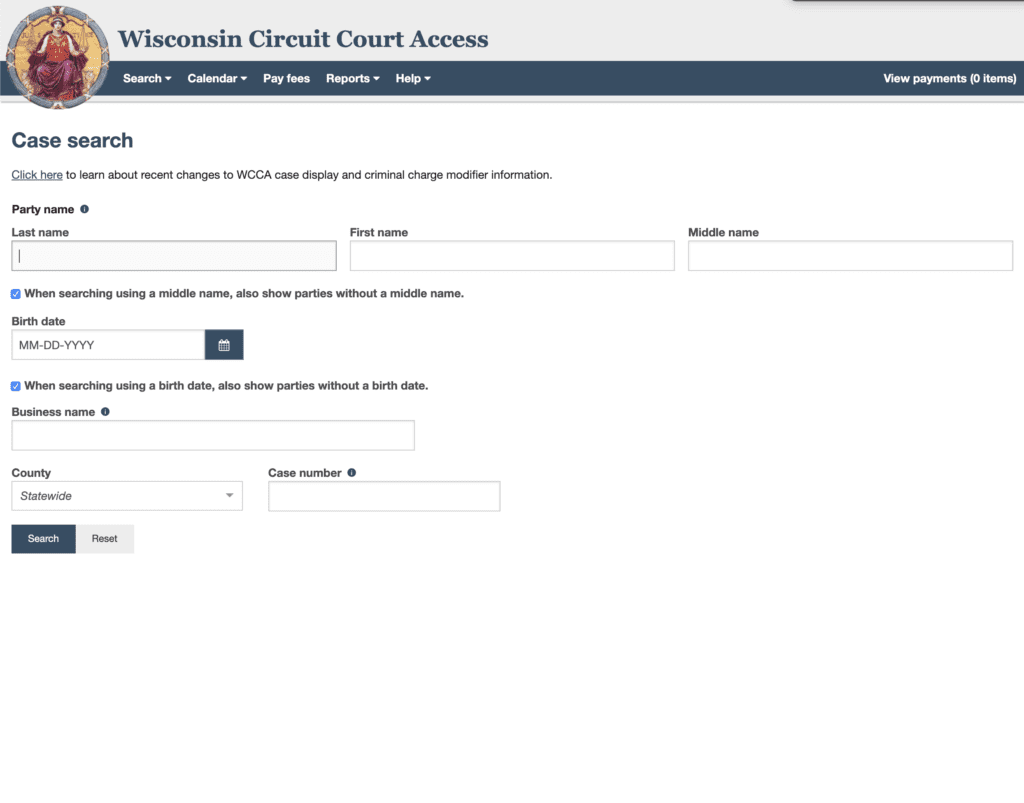
Wisconsin CCAP is a system that allows the general public to look up civil and criminal records throughout the state. Although other states have programs similar to CCAP, this system only covers cases that occur within Wisconsin. The program went online in April of 1999.
CCAP stands for “Consolidated Court Automation Programs.” It is a completely free program. It requires no account and no special registration. Courts do not limit Wisconsin CCAP to criminal defense lawyers, cops, or judges. Anyone can use it. You can search Wisconsin CCAP for criminal records here.
The website exists to comply with Wisconsin open records laws, specifically Wis. Stat. § 19.31, which provides that the public is entitled to “the greatest possible information regarding the affairs of government and its official acts.” CCAP is one thing – there is no difference between “Wisconsin CCAP” and “Milwaukee CCAP.”
Technically, the public website is called WCCA (Wisconsin Circuit Court Access). CCAP is the case management system behind it. But most people use “CCAP” to refer to the website, so we will too.
How long do my records stay on Wisconsin CCAP?
Clients frequently ask us this question. Will my conviction remain on CCAP forever? What if the court dismissed charges? What if I won at trial?
On March 30, 2018, the Director of State Courts, acting on recommendations by the WCCA Oversight Committee, agreed to remove the following cases from Wisconsin CCAP after 2 years:
- Dismissed small claims cases (SC files)
- Dismissed criminal cases, both felony (CF files) and misdemeanor (CM files)
- Acquitted criminal cases, both felony and misdemeanor
- Injunctions under Wis. Stat. ch. 813 for domestic abuse, child abuse, individual at risk, or harassment that resulted in a dismissal or denial
Before this change, dismissed and acquitted cases displayed on CCAP for the same length of time as convictions. That meant a person found not guilty of a felony could see that charge listed on CCAP for 50 years. The 2018 change brought major relief for people who beat their cases or had charges dropped.
For example, the defendant faces a charge for forgery. He beats the charge at trial (an acquittal). The forgery charge remains online for 2 years following the trial. This sounds unfair, but it was a welcomed change. Although the charge name shows up online, it shows “not guilty” next to it for the following two years.
What about dismissed but read-in charges?
Dismissed but read-in charges are legally dismissed. At sentencing, the court considers them. And restitution can certainly be granted based upon a read-in charge. So what happens to read-in charges on Wisconsin CCAP?
Until the full case retention period expires, CCAP retains felony and misdemeanor records. The trial court can overrule this and order that read-in charges be removed from CCAP at the same time period that dismissed charges are. Without that order, a read-in charge will remain online just as long as a conviction.
For example, the defendant is charged with armed robbery (a Class C felony) and obstructing an officer (a Class A misdemeanor). The defendant pleads guilty to the armed robbery. The obstructing is dismissed but read-in. The armed robbery remains on CCAP for 50 years. The obstructing stays online for 20 years, not 2 years.
This is something your criminal defense attorney should raise at sentencing. If the court does not specifically order the read-in charges removed on the shorter timeline, they will follow the full retention period by default.


How long do my convictions remain online and viewable on Wisconsin CCAP?
Upon conviction for a criminal offense, your records remain online for many years. The display periods are governed by Supreme Court Rule ch. 72:
- Civil (CV) cases not small claims: 20 years
- Criminal traffic (CT) cases: 20 years
- Family (FA) cases: 30 years
- Class A felony (CF) cases: 75 years
- Class B through I felony (CF) cases: 50 years
- Forfeiture (FO) cases: 5 years
- Misdemeanor (CM) cases: 20 years
- Traffic forfeiture (TR) cases: 5 years
For example, if the defendant is convicted of substantial battery, a Class I felony, his record will remain on CCAP for 50 years. In another case, the defendant is convicted of misdemeanor battery, a Class A misdemeanor. In the latter case, the record remains on CCAP for 20 years.
One important clarification: these display periods run based on the charges at disposition, not the charges at filing. If a case starts as a felony but is reduced to a misdemeanor through a plea agreement, the misdemeanor retention period (20 years) applies.
What if CCAP shows incorrect information?
CCAP showing the wrong information is another problem. In this case, the defendant can petition the court to seal his or her name from the record. To initiate this action, the defendant completes and files a “Petition and Declaration Concerning Sealing Defendant’s Name from the Court Record Because of Identity Theft or Mistaken Identity” (Form GF-182A). Once completed, a judge reviews the petition using the corresponding order form (GF-182B) and determines whether the information should be sealed.
This remedy is narrow. It only applies to cases of identity theft or mistaken identity, meaning someone else’s charges were attributed to you. It does not allow you to remove a legitimate case from CCAP simply because you do not want it there. But when it applies, it is a critical tool.
CCAP display changes: charge modifications now visible
When you search someone’s name on Wisconsin CCAP, the first thing you see is a case summary page. That page lists the charges, the case type, and the disposition. For years, this summary page only showed the original charges filed by the prosecutor. If those charges were later reduced, amended, or dismissed through a plea agreement, that information was buried deeper in the case record. A user had to click through to “view history and details of charges/sentences” to see the full picture.
That created a real problem. An employer running a quick CCAP search might see “Armed Robbery” on the summary page and stop there. He would never know the charge was reduced to theft through a plea agreement. The summary page told a misleading story for anyone who did not dig further, and most people did not dig further.
The WCCA Oversight Committee recommended fixing this, and the court system implemented the change. Charge modifications now display directly on the summary page. If a felony was reduced to a misdemeanor, or if a charge was amended to a lesser offense, that information appears up front. The result is a more accurate first impression for anyone searching CCAP records.
Eviction records on CCAP: the 2023 rule change
CCAP does not only display criminal records. Civil cases, including evictions, also appear on the system. For years, eviction filings remained visible on CCAP for 20 years under Supreme Court Rule 72.01(8). That meant a tenant who successfully fought an eviction, or whose case was dismissed, could still have that filing follow them for two decades. Landlords routinely search CCAP when screening rental applicants, and an eviction filing alone was often enough to deny housing.
In October 2023, the Wisconsin Supreme Court voted 4-3 to change this. The court amended SCR 72.01 to reduce the display period for eviction cases to two years when no money judgment was entered against the tenant. The final order, 2024 WI 24, resolved a conflict with Wis. Stat. § 758.20(2)(a) and took effect in 2024.
The logic behind this change mirrors the logic behind the 2018 criminal record reforms. A CCAP listing creates collateral consequences that outlast the case itself. A dismissed eviction filing should not prevent someone from finding stable housing years later. The shorter display period does not erase the court record entirely. The physical file still exists at the courthouse, and the case remains available in person for the full retention period. It simply falls off the public website sooner.
This change does not apply to all eviction cases. If a money judgment was entered against the tenant, different retention rules may apply. Tenants with questions about whether a specific eviction filing will be removed from CCAP should consult an attorney or contact the clerk of court in the county where the case was filed.
Can employers discriminate based upon my Wisconsin CCAP record?
Wisconsin law provides protections against employment discrimination based on arrest and conviction records. Under Wis. Stat. § 111.335, an employer may only refuse to hire someone based on a conviction record if the circumstances of the offense substantially relate to the job. That is the legal standard: substantial relationship. An employer cannot reject an applicant simply because a conviction appears on CCAP.
The protections extend to arrest records too. An employer generally cannot even ask about arrests that did not result in a pending charge. And for pending charges, the employer can only consider them if the circumstances substantially relate to the position.
But here is the problem. Wisconsin CCAP makes all of this very easy to circumvent. The database is free, public, and requires no registration. Any employer can search an applicant’s name in seconds. If an employer finds a felony charge on CCAP, even a dismissed one, there is nothing stopping that employer from quietly passing on the applicant and citing a different reason. The applicant may never know that CCAP was the real issue. Proving that an employer violated § 111.335 requires showing that the conviction record was the actual basis for the decision. That is an uphill battle when the employer simply says, “we went with another candidate.”
As criminal defense attorneys, we see this play out constantly. Clients complete their sentences, pay their fines, and do everything the court asked of them. Then they lose job opportunities because a CCAP search paints a picture that no employer wants to look past. The law says employers cannot do this. Reality says they do it all the time. And the 2-year retention period for dismissed charges means that even people who were never convicted face this kind of screening.
What about expungement?
Expungement is the only way to permanently remove a conviction from CCAP. Under Wis. Stat. § 973.015, Wisconsin allows expungement only under very limited circumstances. The defendant must have been under 25 at the time of the offense, the maximum penalty cannot exceed 6 years of imprisonment, and the court must have ordered expungement at the time of sentencing. If the court did not order it then, it is generally too late.
Wisconsin’s expungement law remains one of the most restrictive in the country. Recent legislative efforts to remove the age cap and allow post-sentencing petitions have not passed. We covered this topic in more detail in a separate post on Wisconsin’s expungement law.
When expungement is granted and the sentence is successfully completed, the record is sealed and removed from Wisconsin CCAP. It will no longer appear in a public search. Law enforcement and certain government agencies can still access sealed records, but prospective employers and landlords cannot.
The best way to avoid a Wisconsin CCAP record? Avoid the conviction.
The criminal defense attorneys at Van Severen Law Office focus on avoiding the conviction. If you avoid the conviction, you avoid all the issues described above. Even upon dismissal, a two-year retention period is far better than 20 years. It lets you move forward with your life, your career, and your future.
The 2018 changes and the 2023 eviction record reforms were positive steps. But they are not enough. A person found not guilty at trial should not have to explain a CCAP listing to an employer for the next two years. A person whose charges were dismissed should not lose a job opportunity because a free, public database still shows a case that went nowhere. CCAP listings carry real collateral consequences. They affect employment, housing, professional licensing, and personal relationships. The court system must recognize that a CCAP listing, even a temporary one, is itself a form of punishment.
At Van Severen Law Office, we believe dismissed and acquitted charges should not remain online at all. Until the law catches up, the best defense is avoiding a conviction in the first place. For help with any criminal case in Wisconsin, contact our office. Our criminal defense lawyers respond to phone calls 24/7 at (414) 270-0202.
Frequently asked questions about Wisconsin CCAP
Does CCAP show the actual documents filed in my case?
No. CCAP shows a case summary, the parties involved, hearing dates, charges, and dispositions. The actual documents filed in the case (motions, briefs, police reports) are not available through the website. You must visit the clerk of court’s office in the county where the case was heard to view those documents in person.
Can I remove a dismissed case from CCAP before the 2-year period ends?
Generally, no. The 2-year display period for dismissed and acquitted cases runs automatically. There is no standard process to remove a case earlier unless it involves identity theft or mistaken identity, in which case you can file Form GF-182A. A few judges have exercised discretion to order early removal in unusual circumstances, but there is no statutory right to it.
Do CCAP records affect my ability to get a professional license?
They can. Licensing agencies (including those governing nursing, teaching, real estate, and other professions) may access CCAP records. While Wis. Stat. § 111.335 limits when a licensing agency can refuse to license someone based on a conviction record, a CCAP listing can trigger scrutiny during the application process, even if the case was ultimately dismissed.
Does expunging my record remove it from private background check databases?
Expungement removes the record from CCAP and from the court file. Private background check companies, however, may have already collected the data before expungement occurred. While those companies are supposed to report accurate information, older records sometimes persist in commercial databases even after expungement. You may need to contact those companies directly to request removal.
What is the difference between CCAP and a criminal background check?
CCAP is a free, public database maintained by the Wisconsin court system. It only shows Wisconsin circuit court records. A criminal background check, on the other hand, typically pulls from multiple sources, including the Wisconsin Crime Information Bureau (CIB), federal databases, and sometimes records from other states. CCAP is one piece of the puzzle, but a formal background check is broader in scope.
If I had an eviction filed against me, does it still show on CCAP?
It depends on when the case was filed and how it was resolved. If no money judgment was entered against you, the eviction filing should fall off CCAP two years after the case closed under the 2023 rule change. If a money judgment was entered, the case may remain visible for a longer period. You can search your name on WCCA to check whether the filing still appears. If you believe a case should have been removed and it has not, contact the clerk of court in the county where the eviction was filed.